
Madness Lab
Casual Games


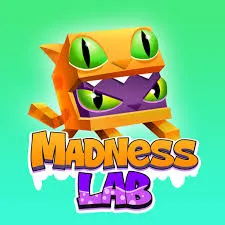
Madness Lab

























| Developer | AZ Games |
| Released | 2025-01-01 |
| Platform | Desktop, Mobile, Tablet |
| Technology | HTML5 |
| Category | Casual Games |
The pitch
Madness Lab is an experiment-sandbox game where you play a mad scientist — pick ingredients, combine them in the experiment station, and deal with whatever happens, which is usually funny and often explosive. It's less a physics game and more a "what does this combination do" discovery toy: you mix, something happens, you laugh, you try another mix. Low stakes, no real fail state, all curiosity-driven.
The discovery loop
The core loop is combine and observe. You pick ingredients from your inventory, put them in the experiment station, trigger it, and see what comes out — and the results are deliberately unpredictable, ranging from useful discoveries to glorious disasters. The fun isn't reaching a goal; it's the curiosity of "what happens if I mix this with that," and the game rewards that curiosity with entertaining outcomes either way. It's a toy built around the question "what if," and that question is the whole engine.
No wrong answers
There's no real fail state, and that's by design. A "failed" experiment — something explodes, a specimen escapes, the lab catches fire — is just as entertaining as a successful one, sometimes more. So there's no pressure to get it right, which makes the game relaxing rather than stressful. You're not trying to win; you're trying to see what happens, and everything that happens is content. That lack of stakes is either soothing or pointless depending on what you want from a game.
The light progression underneath
There is a progression layer — successful experiments earn resources that unlock new equipment and rarer ingredients, which in turn enable wilder experiments — but it's gentle and exists mostly to give you new things to combine, not to gate you behind difficulty. The unlocks feed the curiosity loop rather than challenging it. Don't come in expecting a deep management sim; the progression is a trail of new toys, not a system to optimize.
Honest take
Madness Lab is a light, curiosity-driven sandbox best played in short bursts when you want to mess around and see something funny happen. It's not deep, it's not hard, and it doesn't pretend to be — it's a digital chemistry set where the point is the reaction, not the result. If you enjoy "what if I mix this" experiments and cartoon chaos, it's a pleasant way to spend fifteen minutes. If you need challenge, goals, or skill expression, it has almost none.
How it compares
It's part of the sandbox family alongside Lab Havoc (physics chain reactions) and Melon Playground (open ragdoll sandbox). Madness Lab is the experiment-mixing one — pick it when you want to combine things and discover reactions rather than engineer physics cascades.
What to try first
Start by mixing obvious pairs and watching the range of outcomes — the game wants to show you that "failure" is content, not a dead end, and the quickest way to learn that is to cause a few disasters on purpose. Once you've seen that explosions and escapes are part of the fun, the curiosity loop opens up and you start experimenting freely instead of trying to "win."
From there, the engagement is chasing the rarer outcomes and the unlocks they bring — new equipment and ingredients that enable wilder combinations. It's a gentle spiral of "what else can I mix," and there's no wrong way to approach it. Players who treat it as a checklist stall; players who treat it as a chemistry set to poke at find it keeps revealing new reactions the longer they mess with it.
Quick questions
Do I need to know science? No — the science is fictional and designed for fun. You need curiosity and a sense of humor, nothing else.
Can I fail? Not really. Even disasters are entertaining and part of the experience; there's no hard fail state.
Is there progression? Light — experiments unlock new equipment and ingredients, feeding the discovery loop. Not a deep management system.
Free and in-browser? Yes — no install, plays in the browser.
You May Also Like




Discuss Madness Lab
0 commentsLoading comments...